SparkHub Huddle: What Maldives’ Fintech Startup Founders Are Showing Us

Translated from Dhivehi. Read the original (ދިވެހިން)
Building is one thing. Continuing to build is another.
That was perhaps the strongest takeaway from **SparkHub Huddle – Fintech Edition**: the grit it takes to launch an idea, keep refining it, and continue pushing forward even when the path is uncertain.
Fintech, short for financial technology, is simply the use of technology to make financial services easier, smarter or more accessible, from digital payments and wallets to embedded finance, banking tools and new ways of managing money.
Powered by Bank of Maldives and Mastercard, Huddle brought together the different players shaping the Maldives’ fintech landscape, from startups and entrepreneurs to financial institutions, technology companies and policymakers, creating an open space for conversations about where financial technology in the country is heading.
At the centre of those conversations were the people already building.
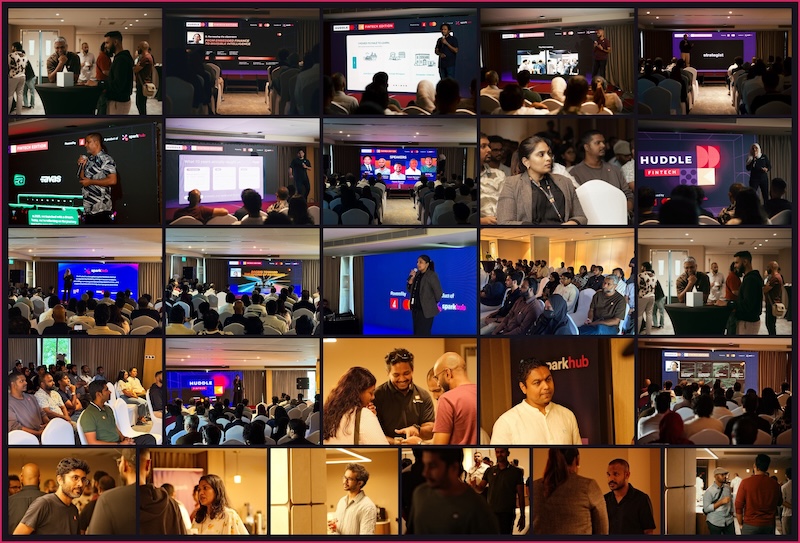
The speaker lineup included Ali Arif, Managing Director of FahiPay; Abdullah Miuvan Shareef, CEO & CFO of eeezap; Ali Haris, Co-Founder of Payer; Hassan Fahmy, Co-Founder of Hubits (Foodops); and Hassan Rameez, Founder & Chairperson of Avas App.
And one thing quickly became clear: these were not simply ideas waiting to find a market.
Across the founders, the number of users, transactions and activity already moving through their platforms was striking. Each had built meaningful traction in its own space, showing that locally developed fintech and digital services are not only being launched in the Maldives, they are being actively used, adopted and scaled.
Across the afternoon, the founders gave a glimpse into what they are building today and, perhaps more interestingly, where they want to take it next.
FahiPay is a Maldivian digital payments app bringing different payment and everyday services together through a digital wallet. Eeezap takes a broader approach as a multi-service platform combining services such as ride-hailing, food delivery, groceries and other on-demand services. Avas App, which began with mobility at its core, is also expanding into a broader everyday-services platform.
That evolution was visible at Huddle itself, where Avas launched its new Pickup and Delivery feature during the event, a practical example of the platform moving beyond rides and adding more services around everyday user needs.
What was particularly interesting was that Eeezap, Avas App and FahiPay are all thinking beyond the individual services they offer today and reaching towards a bigger Super-app vision. Their journeys reflect a growing ambition among Maldivian founders to build platforms that bring more of people’s everyday needs into a single digital experience.
Foodops, meanwhile, is tackling a very different challenge. Positioned as a restaurant platform that goes beyond the traditional POS, it brings together the different parts of restaurant operations from counter and kitchen management to waiter and delivery tools, online ordering, inventory, food costing and financial insights within one system.
At the Huddle, the team also highlighted how quickly businesses can get started, stating that restaurants can be onboarded in as little as five minutes.
One of the most interesting insights was how Foodops is using AI agents to test its services and continuously improve quality. It offered a practical example of AI working behind the scenes ,not simply as a customer-facing feature, but as part of how a technology product is tested and improved.
Then there is Payer, a Maldivian digital wallet offering payment services while also building towards a wider financial technology infrastructure.
Its vision goes beyond conventional payment solutions into wallets, embedded payments and deeper integrations, with AI opening possibilities for managers to better understand and manage their finances.
What stood out was how Payer is making its innovations ready for developers and businesses to integrate into their own solutions. Instead of thinking only about what can be delivered through the Payer app itself, the team is building capabilities that others can potentially plug into and build on opening the door to payments and financial functionality becoming embedded within other digital services.
Different products. Different approaches. But there was a common thread running through all of them:
"persistence".
For founders in a small market like the Maldives, building is rarely a straight line. Products evolve, assumptions change, technology moves quickly, and customers continually raise their expectations. What stood out at Huddle was the willingness of these founders to keep adapting and to think beyond where their products are today.
One of the recurring challenges raised during the Huddle was that innovation does not always move at the same speed as the systems around it. Founders spoke about lengthy regulatory and approval processes, in some cases taking years, as well as the practical difficulties of securing approvals from government authorities and integrating with other service providers.
For fintech companies in particular, these dependencies can significantly shape how quickly a product can move from an idea to something customers can actually use. Integration with banks, payment providers, government systems and other platforms can involve both technical and institutional hurdles.
It added another dimension to the founders’ stories. Their persistence is not simply about continuing to improve a product it is also about navigating regulation, partnerships and complex integrations while continuing to build.
The conversation also widened beyond the local startup ecosystem with Shobhit Arora, Innovation Lead, South Asia at Mastercard, who spoke about the future of payments and the current fintech landscape. He shared Mastercard’s work and efforts within this space, explored emerging opportunities for startups within the evolving payments ecosystem, and discussed how founders can engage with Mastercard and seek support as they develop and scale their solutions.
It brought an important wider perspective to the room: while local founders are solving problems from the Maldives, the technologies, networks and opportunities they can potentially connect to extend far beyond the local market.
But Huddle has never been only about showcasing products.
"Our objective with the Huddle Fintech Edition was very simple: to bring the fintech ecosystem under one roof and establish an environment where startups, institutions, policymakers, and other stakeholders can engage in open discussions. At the same time, we also wanted to expose Maldivian startups to opportunities beyond our small ecosystem and help them understand the benefits of collaborating with a global technology partner like Mastercard. For a small ecosystem like ours, facilitating such connections paves the way for opportunities that individual startups would find difficult to access on their own." — Hussain Jinan, Co-founder and CEO, Sparkhub
It is about hearing what happens behind them the decisions, experiments, challenges and persistence that rarely make it into a product announcement.
And if this edition showed us anything, it is that the next chapter of Maldivian fintech may not simply be about more payment apps.
It may be about super apps, intelligent automation, embedded finance, open integrations, AI-driven services and founders with enough grit to keep building until those ideas become reality.